Evolving user requirements

An internal platform for tax partners to identify and convert business opportunities had critically low adoption.

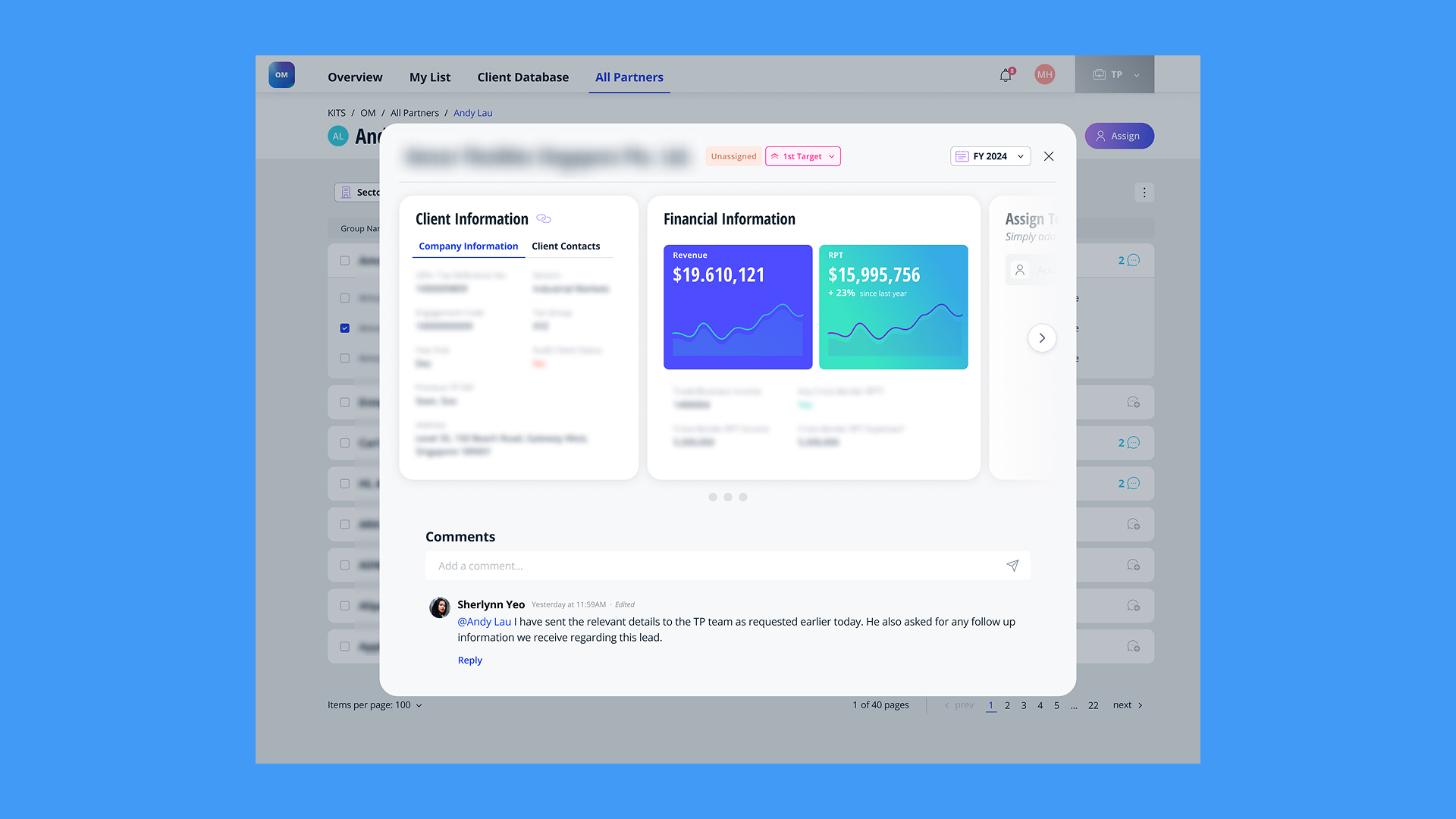
The product was built around data-driven lead management, but partners actually identified opportunities through relationship-based conversations with peers across sectors.
‍
This insight reframed the entire design direction from managing leads to supporting relationship-driven opportunity discovery.
‍
I mapped the revised workflow, identified three core user needs (progress tracking, lead allocation, and cross-partner portfolio visibility), and iterated from lo-fi wireframes through high-fidelity prototypes with continuous user involvement.

Role

User Experience Designer
Co-Product Owner*

Version

2.0 / Live

Timeline

2023 - 2025 Ongoing

Team Members

1 User Experience Designer
1 User Interface Designer
1 Product Owner
1 Data Analyst
Development Engineering Team
2 Champions

Keywords

Discovery
Transformation
Redesign
Dashboard
Stakeholders
Prioritization
Business

Metrics

Beyond lead conversion, I recommended tracking platform adoption rate, monthly active users, and session frequency to validate whether the redesign drove sustained engagement and was not just a short-term spike. Monitoring task completion rates for core workflows (lead allocation, partner portfolio reviews) and time-on-task would further indicate whether the simplified UX reduced friction. These metrics, paired with qualitative feedback channels, would give a fuller picture of whether the product truly fits how partners work.

84.65%

of records actioned by managers, from 33.58%

2 months

Of cost and development savings

45 new LEADS

CONVERTED, grOWING from 6

The workflow that got more complicated and needed many rounds of refinement with users
PowerBI dashboard that users had access to,
which funneled into the final dashboard design (pun intended)
1
2
3
4
5
6